
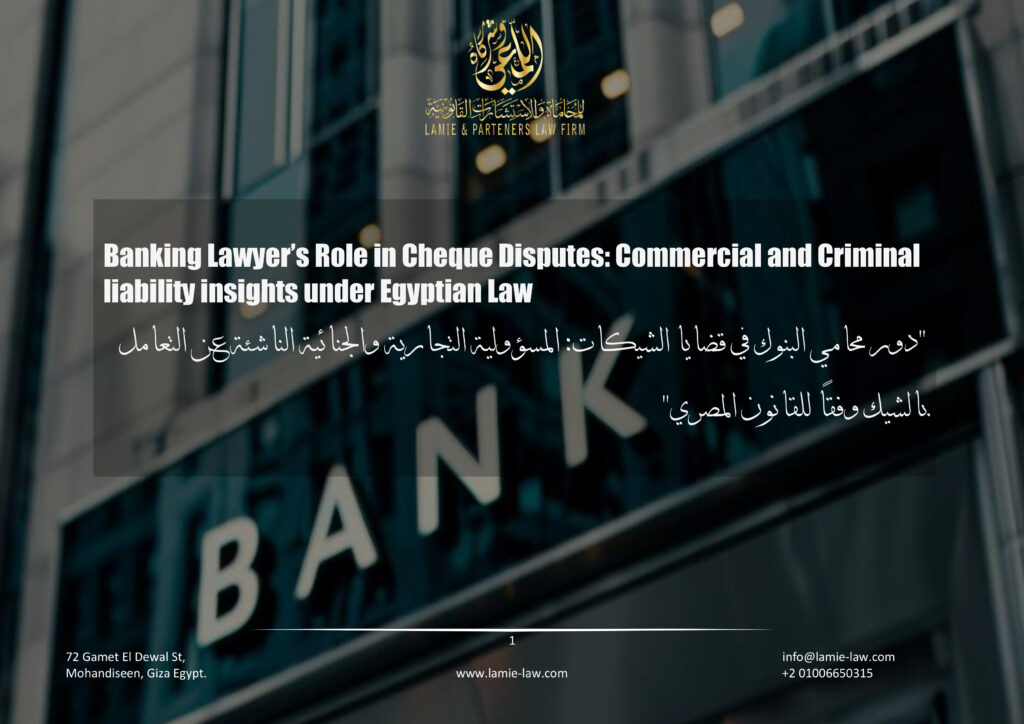
Discover how Egyptian law regulates cheque disputes. Learn about cheque validity, endorsement, guarantor liability, bank refusal, and criminal penalties. Expert insights from banking lawyers in Egypt.
Introduction
Cheques play a pivotal role in commercial transactions and corporate finance in Egypt. They serve as formal negotiable instruments governed by the Egyptian Commercial Code. Disputes related to cheque enforcement often carry both civil and criminal liability, making the role of a skilled banking lawyer in Egypt indispensable for corporates and investors.
The main parties to a cheque are:
- Drawer – the issuer and primary obligor.
- Payee (Beneficiary) – the entitled recipient.
- Drawee Bank – the financial institution ordered to pay.
- Endorser / Endorsee – parties transferring or acquiring ownership.
- Guarantor (Surety) – securing payment under joint liability.
This article outlines key legal provisions governing cheque disputes in Egypt and their implications for corporates, banks, and investors.
1. Mandatory Data on Cheques & Legal Consequences of Omission
To be valid, a cheque must include:
- Issued on the bank’s official form.
- Title “Cheque” on its face.
- An unconditional order to pay in words and figures.
- Drawee bank’s name and place of payment.
- Date and place of issuance.
- Drawer’s signature.
Consequences of omission:
- Missing data (e.g., bank name, signature) invalidates the cheque.
- “Grace rules” apply:
- Missing place of payment → payable at main branch.
- Missing place of issuance → deemed at drawer’s domicile.
- A blank-signed cheque authorizes completion in good faith.
Corporate impact: Companies must ensure compliance with cheque formality rules to secure enforceability.
2. Endorsement in Cheque Enforcement
Endorsement transfers ownership and creates liability for the endorser.
- A “non-negotiable” endorsement restricts transfer.
- Doctrine of “purification of defences” protects good faith holders.
- Procuration endorsement allows collection without title transfer.
Corporate takeaway: Endorsements streamline cheque circulation but must be carefully worded to avoid litigation risks.
3. Secondary Guarantee (Surety) & Recovery Rights
- A guarantor signing a cheque is jointly liable for its payment (Art. 502).
- Even if the main obligation is void (except for formal defects), guarantor liability remains.
- After payment, guarantors may recover amounts from the drawer, endorsers, or prior guarantors.
Corporate impact: Surety clauses provide additional security in high-value corporate transactions.
4. Presentment Period & Payment Priority
- 6 months for cheques payable in Egypt.
- 8 months for foreign-issued cheques.
Priority rules if funds are insufficient:
- Earlier issuance date.
- Lower cheque number (if same date).
- Smaller amount (if from multiple cheque-books).
Implication for corporates: Strict observance of deadlines protects cheque enforceability and claim priority.
5. Currency of Payment Clause
- Payment must be made in the cheque’s stated currency.
- If unavailable:
- Payee may demand payment in EGP at Central Bank of Egypt’s rate.
- Payee may reject alternative currency.
Practical note: This provision protects corporates against exchange rate volatility in cross-border payments.
6. Drawer’s Right to Challenge Payment
Permissible objections include:
- Lost cheque.
- Holder’s bankruptcy or incapacity.
All other objections are invalid unless backed by court orders.
Corporate risk note: Wrongful objections may expose the drawer to criminal liability.
7. Drawee Bank’s Refusal to Pay
- The bank must issue a written refusal certificate (e.g., insufficient funds, forex unavailability).
- Failure to issue is a criminal offence under Article 533.
- Holder may pursue civil claims against drawer and endorsers.
Corporate impact: Banks and corporates must adopt robust compliance systems to avoid criminal exposure.
8. Forged or Altered Cheques & Bank Liability
- Post-alteration signatories are bound by altered terms.
- Pre-alteration signatories remain bound by original terms.
- Bank liability depends on drawer negligence.
Example: If the drawer left blank fields, the bank is not liable for resulting fraud.
9. Expiration of Cheque’s Obligations
- Forfeiture: 6 months (Egypt-issued) or 8 months (foreign-issued) for holder recourse.
- Prescription:
- 1 year vs drawer/endorsers.
- 3 years vs drawee bank.
Corporate note: Tracking these deadlines is critical in commercial litigation strategy.
10. Criminal Sanctions for Cheque-Related Offences
Drawer offences (prison and/or fine up to EGP 50,000):
- Issuing on insufficient funds.
- Post-issuance withdrawals.
- Illegal stop-payment orders.
- Cheques issued in bad faith.
Endorsers/beneficiaries face liability if knowingly circulating underfunded cheques.
Bank employees face fines for misrepresentation or unjustified refusal to pay.
Conclusion
Cheque disputes in Egypt carry serious commercial and criminal consequences. For corporates, compliance with the Egyptian Commercial Code and proactive legal review of cheque practices are essential.
Engaging a banking lawyer in Egypt ensures:
- Proper structuring of cheque-based transactions.
- Defence against civil and criminal claims.
- Stronger negotiation power in disputes.
If your company is facing cheque disputes or requires preventive legal advice, contact our experienced Banking & Finance Lawyers at Lamie Law Firm. Expert Banking & Finance, Corporate Lawyers In Cairo, Giza, Egypt.
Contact Us:
Email: info@lamie-law.com
Mobile: (2+) 01006650315